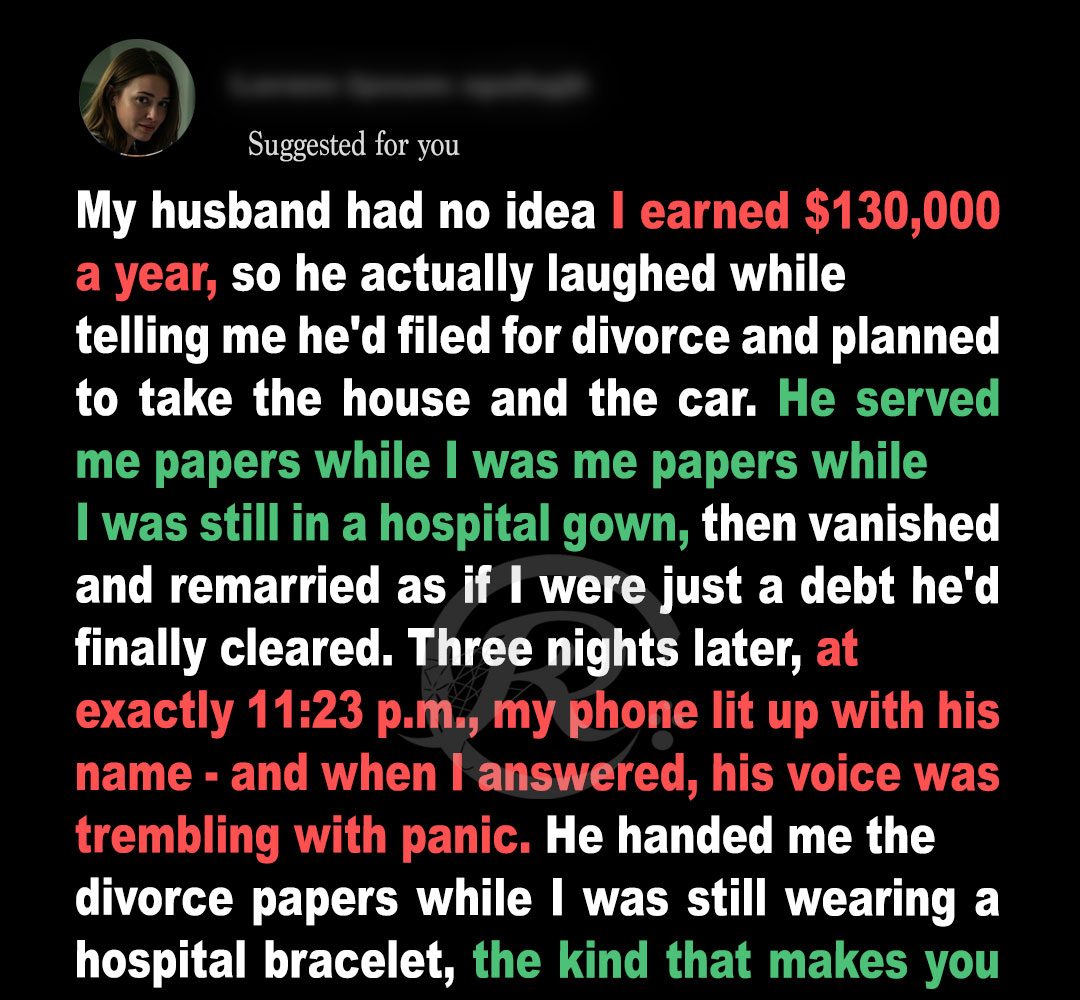
When Marcus walked into my hospital room smiling—not with concern, just smug satisfaction—I didn’t know that moment would flip my life upside down. He walked in while I was still in a flimsy hospital gown and handed me divorce papers like they were gifts. His grin said it all: he thought he’d won.
He laughed as he dropped the envelope in my lap—like it was a joke. “I’m taking the house and the car,” he said, chuckling. I was dizzy, afraid, barely steady, and all he saw was an opportunity. He left without a second thought.
Here’s the shocking part: Marcus didn’t know I earned $130,000 a year. For years he had assumed my career was a hobby, something secondary—something harmless. He never bothered to learn the truth, and that ignorance became his undoing.
By the time I was released from the hospital, Marcus had already moved out—and even remarried like he’d erased me. People expected me to be devastated. I wasn’t. I felt clearer than ever.
Then, at 11:23 p.m. three nights later, my phone lit up with his name. His voice no longer laughed—only trembled. In the background was a woman crying uncontrollably. Marcus begged me to tell him what I’d done.
What he didn’t realize was that that morning my attorney had already filed a strategic response to his divorce petition—documenting every unauthorized transfer, asset concealment attempt, and financial misconduct tied to our joint obligations. Marcus assumed I’d be passive. He was very wrong.
Suddenly, his accounts were frozen. Deposits bounced. His cards declined. The mortgage company put legal holds on the house. Everything he thought he could control slipped out of his hands.
He tried to spin it as a simple misunderstanding. I told him the truth:
He served me divorce papers while I was in a hospital bed, tried to bully me into signing, raided shared assets, and then remarried before finances were settled.
Later, his new wife called—crying, confused, and blindsided. She hadn’t known about his money moves or the real timeline. Marcus had spent their wedding funds from accounts that weren’t rightfully his.
Together, we realized something powerful:
He panicked not because he lost money, but because he lost control of the story.
The legal process moved fast. My attorney presented hospital records, timestamped filings, and proof of asset misuse. The judge sided with fair, not dramatic—granting me protections, access to my accounts, and oversight of shared assets while the divorce continued.
In court, Marcus looked defeated. I didn’t even have to look at him. Outside, he asked to talk—but only through counsel. I walked away knowing one truth:
Closure isn’t always emotional. Sometimes it’s just facts on paper.
Weeks later, Marcus called again—begging. I didn’t answer. Instead, I kept building my life on my own terms: quiet, strong, and entirely mine.
By the end of this whole ordeal, the settlement was fair—no theatrics, just justice. The house was sold and settled equitably, and I kept my financial independence intact.
I still remember the hospital bracelet—white plastic, barcode, identity reduced to a number. But that bracelet became a symbol of transformation, not vulnerability.
Now, every decision, every dollar, and every chapter ahead belongs to me—fully and unapologetically.