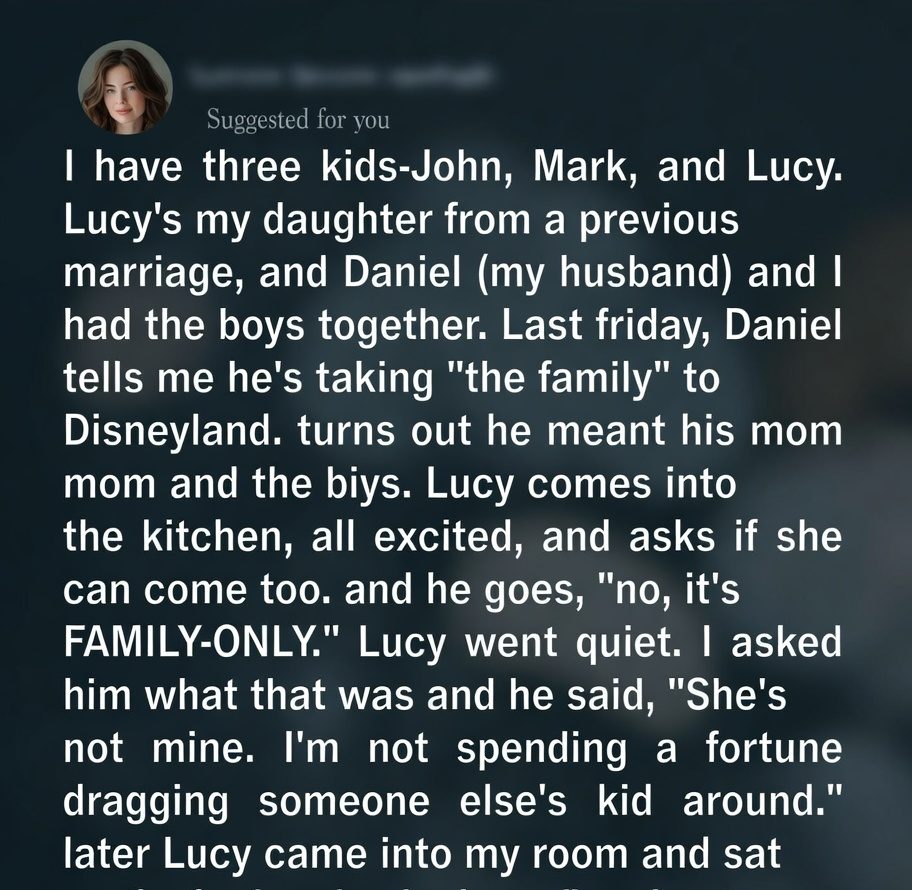
When my husband suddenly announced he was taking our two sons on a “family-only” trip, I didn’t think much of it at first. He framed it as a bonding experience—just him and the boys. But when our daughter asked to go too, everything changed.
He refused.
He insisted it was a “boys-only” trip and claimed she would ruin the dynamic. Our daughter was clearly hurt, even if she tried not to show it. As her mother, I couldn’t ignore how excluded she felt.
So, while they went off on their trip, I decided to do something special for her. We spent the weekend together—shopping, relaxing, and just enjoying each other’s company. It wasn’t extravagant, just meaningful. And for a moment, she seemed happy again.
But when my husband came back, his reaction shocked me.
Instead of being glad she felt better, he was angry. He said I shouldn’t have treated her to anything, claiming I was “rewarding” her for being left out. He even suggested I was giving her the wrong idea—like she didn’t deserve something special.
I couldn’t understand it.
Why was it okay for him to take the boys on a fun trip, but not okay for me to comfort our daughter?
What confused me more was that this wasn’t entirely new behavior. Looking back, there had been subtle moments—times when he prioritized the boys over her or made offhand remarks that didn’t sit right. I had brushed them off before, thinking I was overreacting.
Now, I wasn’t so sure.
Things escalated quickly after that. His attitude toward both of us became colder, distant. Conversations turned into arguments. When we tried to address the issue as a family, he refused to explain himself. Every time we asked why he excluded her, he shut down or walked away.
Eventually, I realized this wasn’t something small. It wasn’t just about one trip.
It was about how he saw our daughter.
And that realization changed everything.
I made the difficult decision to leave with the kids, hoping space would help us figure things out. But instead of trying to fix things, he doubled down—making it clear he only wanted a relationship with our sons, not our daughter.
That was the moment everything became painfully clear.
There was no misunderstanding. No simple explanation.
Just a truth I had been avoiding.
Now, we’re trying to rebuild our lives without him. My daughter is still processing everything, often questioning what she did wrong. I remind her every day—it’s not her fault.
It never was.
And while the future feels uncertain, one thing is clear: protecting my children comes first. Even if it means walking away from the person I thought I knew.