When my husband Daniel first offered to stay home with our baby so I could go back to work, I honestly thought I’d hit the jackpot — a clean house, a happy child, home-cooked dinners, and a partner who actually meant it.
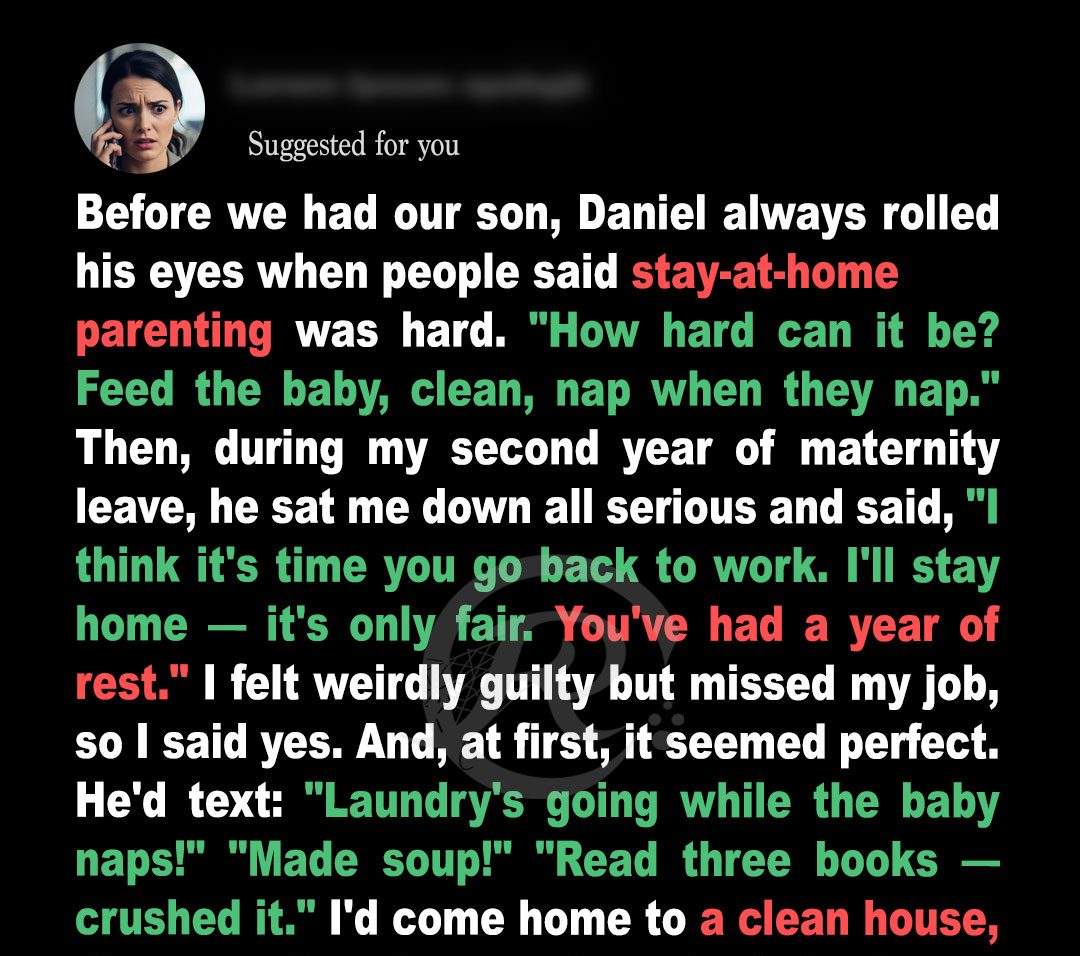
Before our son Cody was born, Daniel used to laugh off how tough stay-at-home parenting could be. “Feed him, change a diaper, put him down for a nap… it’s not rocket science,” he’d say with a smug grin. I didn’t argue — I was too pregnant, too tired, and not ready for that fight.
Fast forward two years into my maternity leave, and we were finally talking about what would happen when it ended. I had worked hard to build my career, and returning to work meant financial security for our family. Daniel insisted he’d handle the baby full-time — that it would be “no problem at all.” I believed him.
So he stayed home. At first, it seemed like a dream: cooked meals, a tidy home, a baby who laughed and reached for his dad. Daniel proudly told anyone who’d listen that he was the one at home now while I returned to work. I was relieved… and appreciative.
Then one afternoon, Daniel’s mother called out of the blue — and everything changed.
Her reaction wasn’t warm.
In fact, she accidentally revealed that Daniel hadn’t been keeping up with things at all. She mentioned — almost too casually — that he’d complained to her about how hard it was to take care of Cody and the house. She expected a little praise from me, she said, but instead she gave a half-truth that hit me like a wave:
Daniel was telling his own family he was overwhelmed and unhappy.
My stomach dropped. I wanted to believe it was just stress talking, but the signs were all there. Daniel wasn’t just struggling — he was complaining about being a stay-at-home parent, even to his mother. And the conversations had started to paint a very different picture of our perfect-sounding arrangement.
It made me wonder:
Did he really mean what he said when he offered to stay home?
Was it about helping us — or about getting me out of the house so he didn’t have to juggle chores and career expectations?
Those questions sat heavy in my mind. Because suddenly, things that once looked perfect felt fragile — and maybe built on an idealized version of reality that no longer existed.
In the end, I realized the promise of support had to match the action of support — not just words, not just a social media story, and not just an image of a “perfect family life.” Real teamwork means showing up even when it’s hard, not only when it looks good.