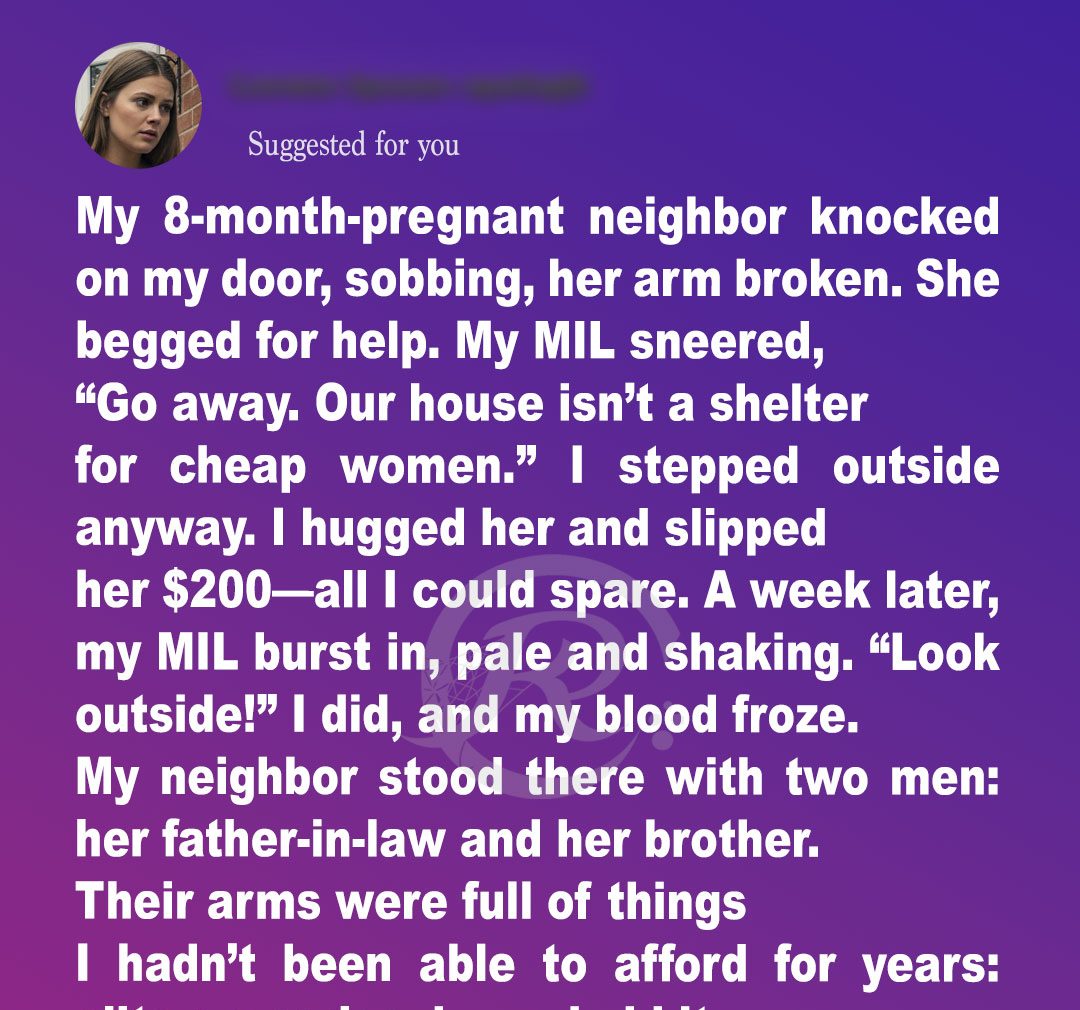
When my pregnant neighbor — eight months along, wounded, and scared — knocked on my door with a broken arm, I didn’t know that one choice would change everything. My mother-in-law, Marlene, sneered from behind me:
“Our house isn’t a shelter for cheap women.”
But I stepped outside anyway. I hugged the trembling woman and gave her every dollar I had — $200 — the only cash I could spare. That moment didn’t feel like much at the time, but it set into motion a chain of events far bigger than any of us expected.
A week later, fear hit my home like a thunderbolt. My mother-in-law rushed in, pale and shaking, shouting:
“Look outside!”
At first I hesitated — until I saw it: a convoy of sleek black and silver cars parked along our curb, men in suits with earpieces, a woman with a clipboard. They looked like they belonged outside a courthouse, not a quiet neighborhood street. And there, standing tall under a winter tree, was Lina — the neighbor I had helped — flanked by uniformed officers and two strangers with kind eyes.
The woman with the clipboard introduced herself as a representative of victim services and a private foundation that supports domestic violence survivors. She explained that Lina was now safe, placed under a protection plan, and her abuser had been arrested and charged — because she had reached out for help and documented her abuse.
Marlene scoffed at first, insisting Lina had no real need for help. But the situation wasn’t a game — and the evidence proved it. Every bruise, every message, every hospital report lined up. My husband, Evan, stood stunned as the truth unfolded.
The woman continued with something deeper: Lina’s father, Mr. Alvarez, had been searching for her for years. When I let Lina use my phone, she managed to reach out to her family — and that message created the paper trail authorities needed to locate her and bring her abuser to justice.
The room fell silent. Evan’s voice was quiet but firm:
“You chose cruelty over help.”
Marlene tried to defend herself, but the presence of the police, the foundation team, and Mr. Alvarez himself made it clear — she couldn’t rewrite reality.
Mr. Alvarez thanked me personally. He handed me two envelopes: one from his daughter and another with information about support services for families who open their homes to survivors. It wasn’t charity — it was acknowledgment, validation, and hope.
That night, I read Lina’s letter. Her words were simple but powerful:
“You treated me like a human being when others turned away.”
She wrote that my $200 had helped pay for her ride to medical care — and that act of kindness had kept her alive long enough for her family to find her.
A week later, Lina welcomed a healthy baby boy into the world. Mr. Alvarez sent a thank-you card — no gifts, no demands, just genuine gratitude for something many people would overlook: human decency.
And my mother-in-law? She didn’t speak to me for months. Eventually, though, her silence didn’t feel like punishment — it felt like peace. I learned something profound through all of this:
A home isn’t defined by who you keep out — it’s defined by who you choose to protect.