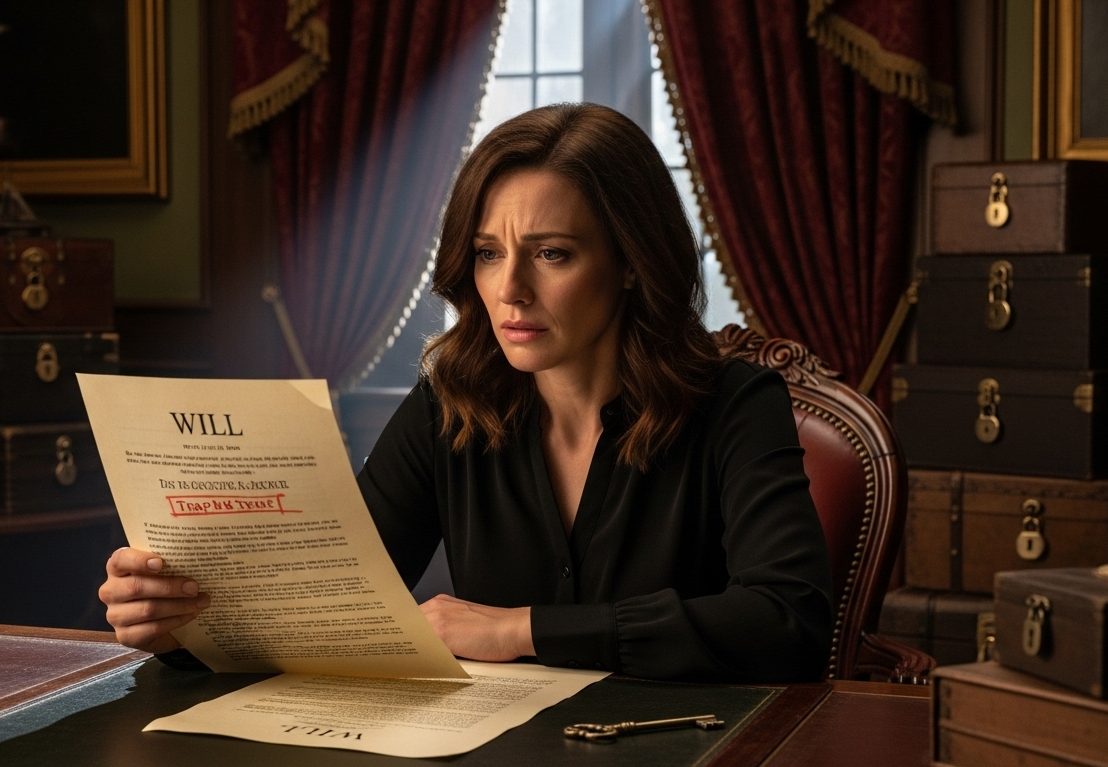
When my mother-in-law passed away, I expected grief.
What I didn’t expect was the shock that followed.
The entire family gathered at the lawyer’s office for the reading of her will. Her two children—my husband and his sister—sat quietly, both assuming the inheritance would be divided between them.
That’s how things usually work.
But the lawyer cleared his throat, opened the document, and began reading.
Within seconds, the room turned silent.
According to the will, almost everything she owned—her house, savings, and most of her belongings—had been left to me.
Not to her own children.
To me.
At first I thought I misunderstood.
I glanced around the room, expecting someone to correct the lawyer. But the words were clear. My name appeared again and again throughout the document.
My husband looked stunned.
His sister looked furious.
“Why would Mom do that?” she demanded, her voice shaking with disbelief.
The lawyer simply pointed to the final pages. There, written in my mother-in-law’s own words, was an explanation.
But before anyone could read it, tension exploded across the room.
My sister-in-law accused me of manipulating their mother. She insisted I must have convinced her somehow, planting ideas in her mind during the last years of her life.
The accusation hurt.
Because the truth was much simpler.
During the last five years of her life, my mother-in-law had been sick. Her health slowly declined, and daily tasks became difficult for her.
At first, everyone promised to help.
But life got busy.
My husband traveled often for work. His sister lived in another state and rarely visited.
So I stepped in.
I drove her to doctor’s appointments, helped with groceries, and spent countless evenings sitting beside her while she talked about memories from her younger days.
None of it felt like a burden.
She was family.
Over time, we grew incredibly close. She shared stories about her childhood, her marriage, and even the regrets she carried.
Sometimes she would squeeze my hand and say quietly, “You’re the only one who really sees me anymore.”
I always thought she was just being emotional.
I never imagined she would leave me anything.
Back in the lawyer’s office, the tension remained thick.
Finally, the lawyer read her message aloud.
In it, she explained that love and care mattered more to her than blood alone.
She wrote that during her final years, she often felt forgotten by those she expected to rely on. But one person consistently showed up, day after day, without asking for anything in return.
That person, she wrote, was me.
She didn’t leave me everything to create conflict.
She did it because she believed kindness should be recognized.
When the letter ended, the room fell silent again.
My husband looked down at the table, clearly overwhelmed.
His sister stared at me with a mixture of anger and disbelief.
But I didn’t feel victorious.
If anything, I felt heavy.
Because inheritance can change relationships in ways no one expects.
Later that evening, my husband and I talked for hours. I told him the money and property meant far less to me than keeping peace in the family.
In the end, we decided something important.
We would share the inheritance fairly between everyone.
Not because we had to.
But because sometimes the real value of a gift isn’t what you receive—it’s what you choose to do with it.
And that was the lesson my mother-in-law had unknowingly left behind.