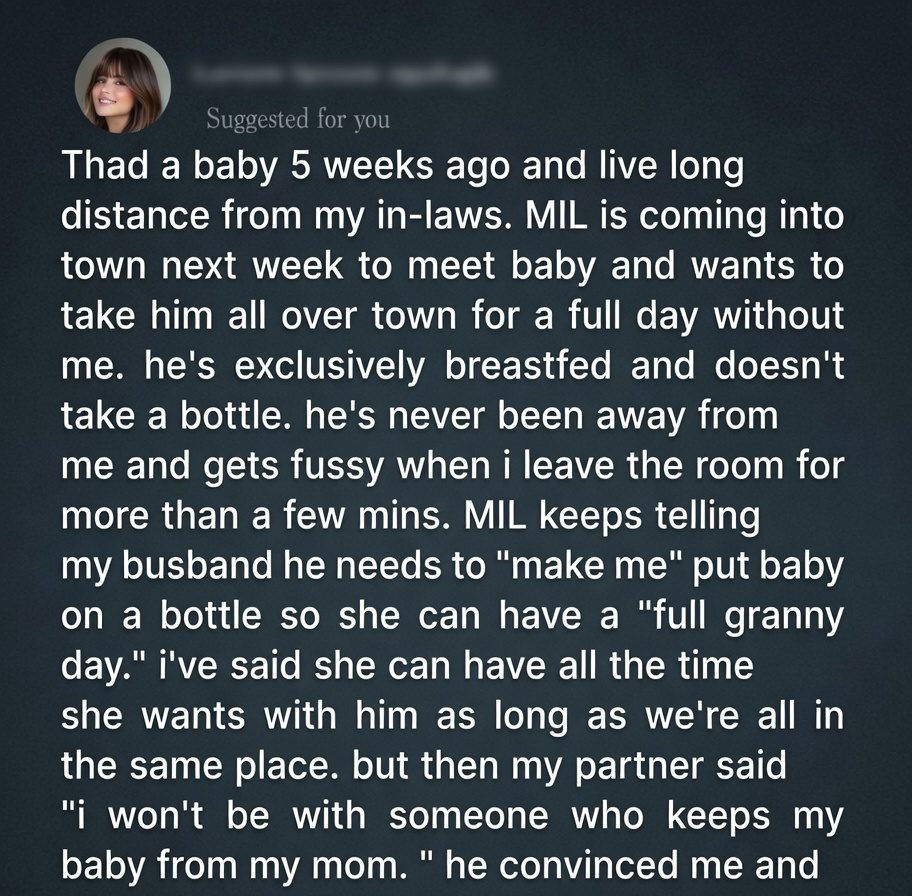
Becoming a mother should’ve been one of the happiest times of my life. My baby was only five weeks old—tiny, fragile, completely dependent on me. I was still recovering, still learning, still adjusting to this overwhelming new world.
And yet, instead of support… I got pressure.
It started subtly.
My mother-in-law would make small comments whenever she saw me breastfeeding. At first, she’d just watch quietly, her expression unreadable. Then came the remarks—soft, but sharp enough to sting.
“You’re still doing that?”
“Isn’t it time to switch to formula?”
I tried to ignore it. I told myself she meant well, that maybe it was just generational differences. But deep down, I felt judged—like I was doing something wrong by choosing what felt natural for my own child.
But then one day, she crossed the line.
She sat me down and told me directly that I needed to stop breastfeeding.
Not suggested. Not advised. Told.
She said it wasn’t “necessary,” that it made her uncomfortable, and that formula would be “better” anyway. She spoke like she had authority over my body, my baby, my choices.
I was stunned.
My baby was only five weeks old. FIVE. And she wanted me to stop something essential—not just for nutrition, but for bonding, comfort, and health.
I looked at my husband, expecting him to step in.
Instead… he hesitated.
That hesitation hurt more than her words.
I felt alone in that moment—like I had to defend myself in my own home, for doing something completely natural as a mother.
But something inside me snapped.
I calmly told her no.
Not angrily. Not dramatically. Just firmly.
I explained that this was my child, my decision, and I would not stop breastfeeding just because it made her uncomfortable. I told her I had done my research, listened to medical advice, and trusted my instincts as a mother.
She didn’t take it well.
Her tone changed. She became cold, distant, even dismissive. Suddenly, everything I did was wrong in her eyes—from how I held the baby to how I scheduled feedings.
The tension in the house grew heavier each day.
And my husband? Still stuck in the middle.
But I wasn’t backing down.
Because this wasn’t just about feeding—it was about boundaries.
It was about respect.
It was about realizing that becoming a mother also meant finding your voice, even when it shakes.
Days later, things escalated again. She tried to interfere directly—offering formula behind my back, questioning my choices in front of others, even implying I was being selfish.
That’s when I drew the line.
I told my husband we needed to talk—really talk.
I explained how alone I felt, how disrespected I was in my own space, and how this couldn’t continue. I wasn’t asking for permission—I was asking for support.
And finally… he understood.
He spoke to his mother.
Firmly.
For the first time, he made it clear that this was our child—not hers—and that decisions about our baby belonged to us alone.
She didn’t like it.
But things changed.
Not perfectly. Not overnight. But enough.
Because sometimes, standing your ground doesn’t just protect your choices—it teaches others how to treat you.
And as I held my baby close, I realized something important:
Being a new mom isn’t just about caring for your child…
It’s also about learning to protect your peace.