Dave used to be the man of my dreams — the guy who’d show up at my door with a slice of key lime pie after driving three hours through a thunderstorm just to see me smile. That was before marriage.
After the wedding, it felt like he swapped that thoughtful partner for someone who wielded sarcasm like a weapon and called it “comedy.” What started as harmless teasing in private quickly spilled into public humiliation. At first, I chalked it up to him being quirky — a tease here, a flirtatious comment there. But week after week, joke after joke, it wore me down.
I tried being the “cool wife.” I laughed when he winked at cashiers after joking about my outfit. I laughed when he flirted shamelessly with strangers at parties. I laughed when his eyes lingered a moment too long. He’d just smirk and say, “I was only kidding, where’s your sense of humor?” And eventually, I began to wonder if I did lose it.
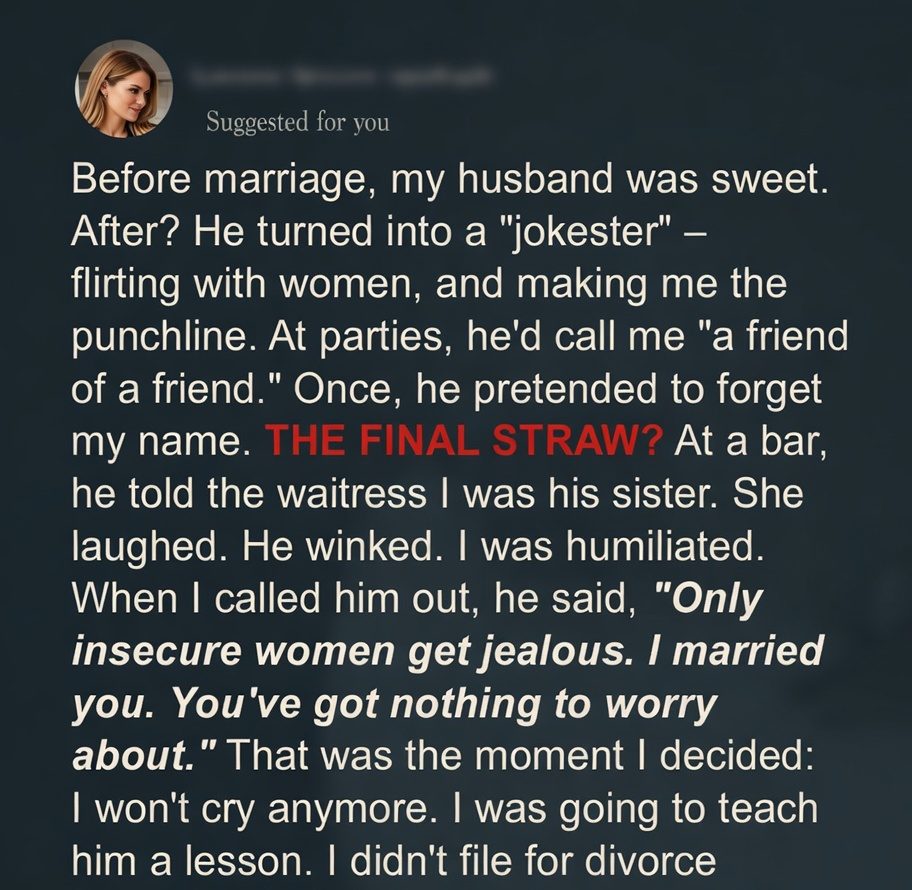
At gatherings, he’d make comments about me as if I wasn’t sitting right there. One night, at a friend’s party, he introduced me not by name but as “a very dear friend of a friend.” That was supposed to be funny. The room laughed. I forced a tiny smile, but inside I was crumbling.
It wasn’t funny. It felt like I was becoming a punchline — a character in his eternal skit at my expense.
The breaking point came one Tuesday night at our usual bar. I had spent the evening trying to be present — laughing with the bartender, enjoying a glass of wine, even flirting back with life. When I stepped away for a moment, the waitress turned to Dave and said, “Oh my God! Seriously?” Then, pointing at me, “Your brother is hilarious!”
“Brother?” I heard that word like a glass shattering. My face went hot as ice spread through my veins. I looked at him — really looked at him — and for the first time in months I saw a stranger wearing my husband’s grin.
“Not funny,” I said quietly. “It’s humiliating and dismissive. I’m your wife, not your punchline.”
He just laughed it off, brushing my feelings aside with a mocking, “Only insecure women get jealous, babe. I married you. You have nothing to worry about.”
That line — that dismissive, condescending retort — had been his go‑to for months. Every time I tried to talk about how his remarks hurt me, he’d smirk, disarm the moment, and make it seem like my feelings were the punchline.
That night, something inside me snapped.
I realized this wasn’t about jealousy. This was about respect — or the lack of it. I decided right then I wouldn’t let him twist my vulnerability into a laugh line anymore. I would take back the narrative — but on my own terms.
I started plotting quietly. Not a fight. Not a scream. Not something ugly. Just a reversal — a performance that would show him exactly how twisted his idea of “funny” really was.
With our anniversary approaching, I told Dave I had a surprise planned — something special.
“Oh, what kind of surprise?” he asked, grinning like a child who already knew the punchline.
I led him to the rooftop restaurant where we’d had our first date, the same table, the same view of the glittering cityscape that felt like a carpet of stars. His eyes softened. He reached for my hand, smile bright.
“I thought it was poetic to end things where it all began,” I told him.
He beamed — genuinely this time — leaning forward in anticipation as I slid a crisp white envelope across the table. His grin faltered just slightly. Then curiosity got the better of him and he opened it.
Inside were signed and notarized divorce papers.
His mouth hung open, uncomprehending at first.
“If you’re joking, honey…” he stammered.
I didn’t laugh. I just smiled back — calm, collected — and let his silence fill the space. I didn’t have to shout. I didn’t have to accuse him. I just gave him exactly what he’d been giving me all along: a moment that wasn’t funny. A moment that hit.
“For the first time in months,” I said softly, “you’re speechless.”
I kissed his cheek — a final act of closure — and walked away into the night.
No yelling. No tears. No drawn‑out drama.
After that night, he called and texted with a flood of excuses, apologies, rewrites of reality, pleas that maybe we could work it out. But I didn’t answer. Not once. I didn’t block him — I didn’t have to — I just let the silence speak for me.
Now I live in a sunlit apartment with wood floors that gleam in the morning, soft music playing at night, and laughter that belongs to me again. I sleep diagonally across the bed, unshared. I eat ice cream for dinner when I want. I laugh only when it truly feels like laughter — not because someone else expects it, or because someone else thinks it’s amusing.
I reclaimed my joy, my voice, and my dignity — no punchlines needed.
And that, my friends, is the story of how I turned the joke back on him.