When my dad announced he was getting married again, I genuinely wanted to be happy for him.
After years of it being just the two of us, I knew he deserved companionship. And when I met his fiancée, she seemed… fine. Not overly warm, not particularly cold — just someone I thought I could coexist with.
At first.
As the wedding planning began, I assumed I’d naturally be included. After all, I was his daughter. I imagined being part of dress fittings, helping choose decorations, maybe even sharing a small bonding moment with her.
But that wasn’t how things unfolded.
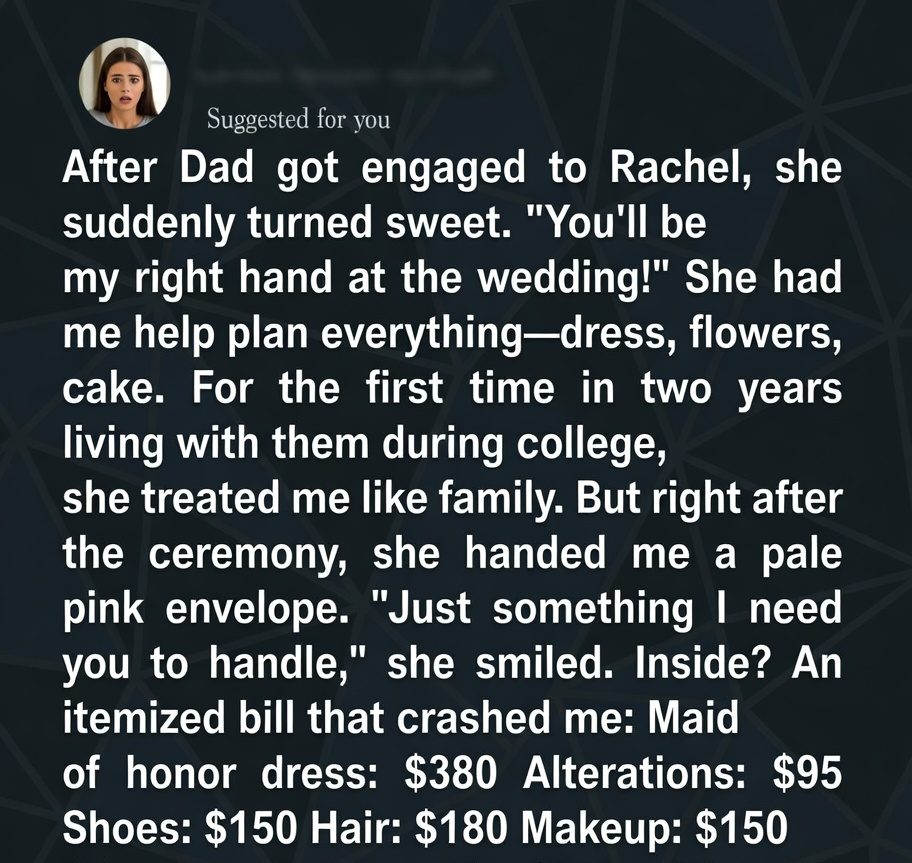
One evening, she sat me down with a tight smile and a tone that already felt off. She explained that while I would be part of the wedding, I needed to “handle my own expenses.” That meant my dress, my shoes, my hair, my makeup — everything.
I blinked, thinking I misunderstood.
“Wait… you mean I’m paying for all of it?” I asked carefully.
She nodded, as if it were completely normal. She even added that it would “teach responsibility” and that since I was “old enough,” I shouldn’t expect to be taken care of anymore.
The words stung more than I expected.
This wasn’t some distant relative’s wedding. This was my father’s wedding — and I wasn’t being treated like family. I was being treated like an outsider.
Still, I didn’t want to cause drama. My dad seemed happy, and I didn’t want to ruin that. So I agreed, even though it meant draining most of my savings just to be presentable at his wedding.
Weeks passed, and every small detail reinforced the same message: I didn’t belong in her version of this family.
She controlled everything — the guest list, the seating, even the tone of conversations. And every time I tried to get closer or offer help, she’d subtly shut me out.
But the real turning point came just days before the wedding.
I overheard her talking on the phone, laughing lightly as she said something that made my chest tighten:
“She can pay for her own look. I’m not wasting money on someone who’s not even really part of my life.”
That was it.
Something inside me shifted.
I had stayed quiet, respectful, and patient. I had tried to give her the benefit of the doubt. But hearing that — hearing how she truly saw me — made everything clear.
I wasn’t just excluded. I was unwanted.
So I made a decision.
On the wedding day, I showed up exactly as planned — dress, hair, makeup, everything done perfectly. If she expected me to fade into the background, she was about to be disappointed.
The ceremony started beautifully. Guests smiled, music played, and everything looked picture-perfect on the surface.
But appearances can be deceiving.
When it came time for speeches, I stood up.
There was a slight pause — a flicker of surprise from her — but she couldn’t exactly stop me without causing a scene.
I smiled politely, took a breath, and began.
At first, I kept it light. I spoke about my dad, about how much he meant to me, about the years we spent together before everything changed.
Then, gently but unmistakably, I shifted.
I talked about what family means. About inclusion, respect, and how important it is to make people feel valued — especially on days that are supposed to celebrate love and unity.
The room grew quieter.
I didn’t insult her. I didn’t raise my voice. I simply told the truth — the kind that lingers in the air long after it’s spoken.
And people understood.
You could see it in their faces. The glances. The subtle tension.
By the time I finished, the atmosphere had changed.
She forced a smile, but it didn’t reach her eyes.
My dad looked… conflicted.
And for the first time since all of this began, I didn’t feel small.
I felt seen.
After the wedding, things were never quite the same. The polished image she tried so hard to maintain had cracked, and people began to notice what had always been there beneath the surface.
As for me?
I stopped trying to earn a place where I was never truly welcome.
Because sometimes, the most powerful thing you can do isn’t to fight loudly — it’s to stand calmly in your truth and let everyone else see it.