I still remember the night Peter died like it was yesterday — not distant, not softened by time, just raw and cruelly sharp.
They say grief hits you like an out‑of‑the‑blue truck. They’re wrong. A truck would be over in seconds. Grief is like drowning in slow motion while the world around you keeps breathing like nothing’s happened.
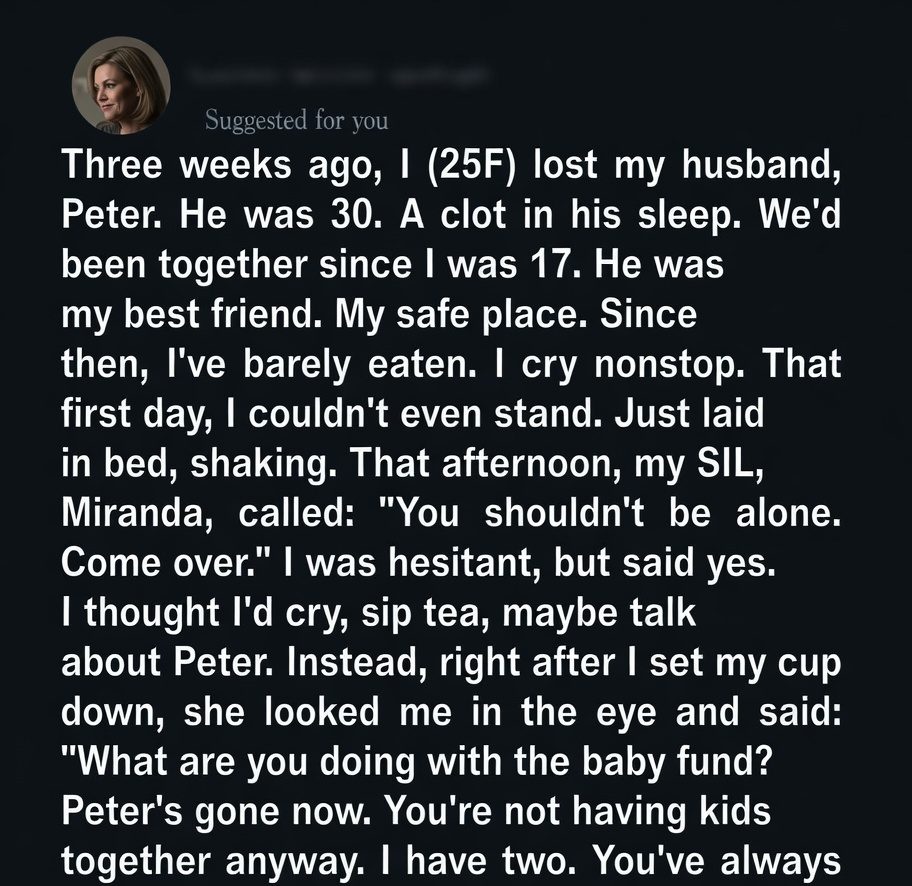
Peter died three weeks ago — late at night, suddenly, without warning. One moment he was beside me, the next he wasn’t. The doctor said a pulmonary embolism. I replayed it in my head endlessly. Had I just listened to him about that calf pain two days before… maybe this wouldn’t have happened.
I was shattered — unable to eat, to move, to breathe normally. I lay curled around his pillow for days. Peter had been my safe place — my anchor. And with him gone, I felt completely untethered.
Then the phone buzzed. It was Miranda — my sister‑in‑law. Her voice was gentle, careful:
“Kate, you shouldn’t be alone. Come over. I made tea.”
She sounded like comfort. A lifeline. Someone who cared.
So I agreed.
I went over with shaky legs, wearing Peter’s hoodie — the one that still smelled like him. But the moment I stepped inside Miranda’s house, that small hope of comfort dissolved.
The tea was too sweet. The room felt too normal. And then Miranda looked at me — not with sympathy, but with something else entirely.
“What are you doing with the baby fund?” she asked.
I stared at her blankly.
“The baby fund,” she repeated. “You and Peter had that set aside… you’re not having kids together now, so why not give it to me? For our girls’ college.”
My heart sank. I hadn’t even thought of the money, lost in a fog of grief. But the baby fund — that was the dream Peter and I held tight for years. And she was asking for it like it was her right.
Then she slid a piece of paper across the table — a list of chores she expected me to help with for her children. Pick up kids from school, help with homework, bake cookies for the fundraiser. All while I could barely look after myself.
I sat there, tears gathering, unable to find my voice.
She smiled like she was doing me a favor.
“I thought it might keep your mind off things,” she said.
Before I could respond, there was a knock at the door. It wasn’t dinner or deliveries. It was Susan — my mother‑in‑law.
Susan didn’t waste words. She stood there, eyes fierce:
“Miranda, you will never see a dime of that money.”
Her voice was firm, steady — nothing like Miranda’s self‑centered pitch.
Miranda spluttered, but Susan didn’t back down. She called out her daughter’s behavior — using me while I was grieving, leveraging my pain for what she wanted.
I left that day shaken — torn between heartbreak and fury. On the drive home, silent and trembling, I realized something profound about loss, love, and people who think they care but only care about what they can take.
That night, I got a message from Miranda loaded with blame, but I didn’t reply. I deleted it and set my phone to silent. I was still broken. Still hurting. But I was also starting to understand something Peter used to say:
“Some people love you because you are useful. Others love you because you are you.”
And for the first time since he died, I felt a little less alone.