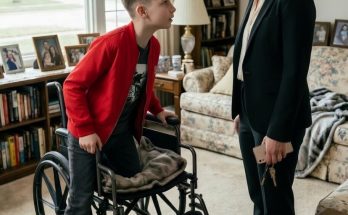
When my mother‑in‑law handed my nine‑year‑old daughter a silver picture frame at her birthday party, I thought it would be a sweet moment. What was inside changed the entire room — and left my daughter’s heart breaking.
Emma isn’t just a child — she is my world. Her laugh, her curiosity, her messy hair in the morning… she’s the reason I wake up every day. She’s been loved, cared for, and cherished since the moment she entered my life.
But Emma isn’t my husband Brian’s biological daughter. Her real father, Max, tragically died in a car accident when she was only two. I was a widow in my twenties, carrying the weight of grief while trying to raise a toddler on my own — working double shifts at the bank just to get by.
Then one day, at a coffee shop, Brian walked into our lives. He didn’t shy away from us — and from day one, he treated Emma like his own. From father‑daughter dances to teaching her how to ride a bike, he showed up. Real, committed, gentle presence. We fell in love, got married, and for the first time, I believed we’d found our happily‑ever‑after.
But there was one person who never really embraced our little family: Brian’s mother, Carol. She never said outright that Emma wasn’t family, but her actions whispered it loudly — the cold looks, the unequal holiday gifts, the subtle reminders of “blood family” versus “step‑family.” Brian always defended us… but Carol never softened.
Then came the birthday party. Balloons and laughter filled the backyard. Emma, in her favorite blue dress, blew out her candles with pure joy. After cake, she opened Carol’s gift — a beautiful silver frame engraved with “Family Is Forever.”
It should have been a touching present. But when Emma unfolded the photo collage inside, the air dropped. There were pictures of Christmases and lake trips — everyone was in it… except Emma and me.
I watched my daughter’s smile fade. She blinked, hurt rising in her eyes, not quite understanding why she wasn’t there — why we were left out of something meant to celebrate family.
Carol looked unbothered as though the omission was normal — a quiet message about who truly belonged. In that moment, something in me snapped. But before I could say a word, Emma set the frame down quietly and looked straight at Carol.
“Grandma,” she said softly, “you don’t love me — and that’s okay. I love Mommy and Daddy. And I just thought… maybe one day you’d love me too.”
Silence. Everyone froze. Carol turned, eyes wide, then walked inside wordlessly. The party dissolved.
I rushed to Emma’s side and held her tight, expecting tears — but she stayed still, eyes thoughtful, like someone who’s learned disappointment too many times before.
Brian confronted Carol privately with an anger she couldn’t defend. Minutes later, though, she reemerged — vulnerable, emotional, and sincere. Tears streamed as she knelt before Emma and apologized. She admitted her jealousy and fear had warped her heart, and that she was wrong.
Emma looked at me, then slowly accepted a hug from her grandmother — and in that moment something shifted. A small barrier cracked.
In the months that followed, Carol tried. She came to Sunday breakfasts, helped Emma bake pancakes, and even brought a real birthday gift one Christmas — a jewelry box with a tiny ballerina inside that Emma adored.
And last summer, nearly a year after that painful day, Carol surprised us all. She booked a park photoshoot — a real family portrait — and this time Emma was front and center… embraced, loved, and fully included.
Now that photo sits on our mantle — not just as a picture, but as proof that even the sharp edges of rejection can soften, and that family isn’t defined by biology, but by love and belonging.