Twenty years after my mother walked out of my life with nothing but excuses, she showed up at my front door with a grocery bag and one desperate sentence: “You have to help me.””
My name is Stacey, and as a child I believed in her — even when she shattered my world. My father disappeared before I could remember his face. All I knew of him was a name on a birth certificate.
But my mother, Melissa, was a different story. She filled our tiny, run-down home with anger, exhaustion, and endless frustration. I vaguely remember her working at a grocery store and returning home worn — but never showing love.
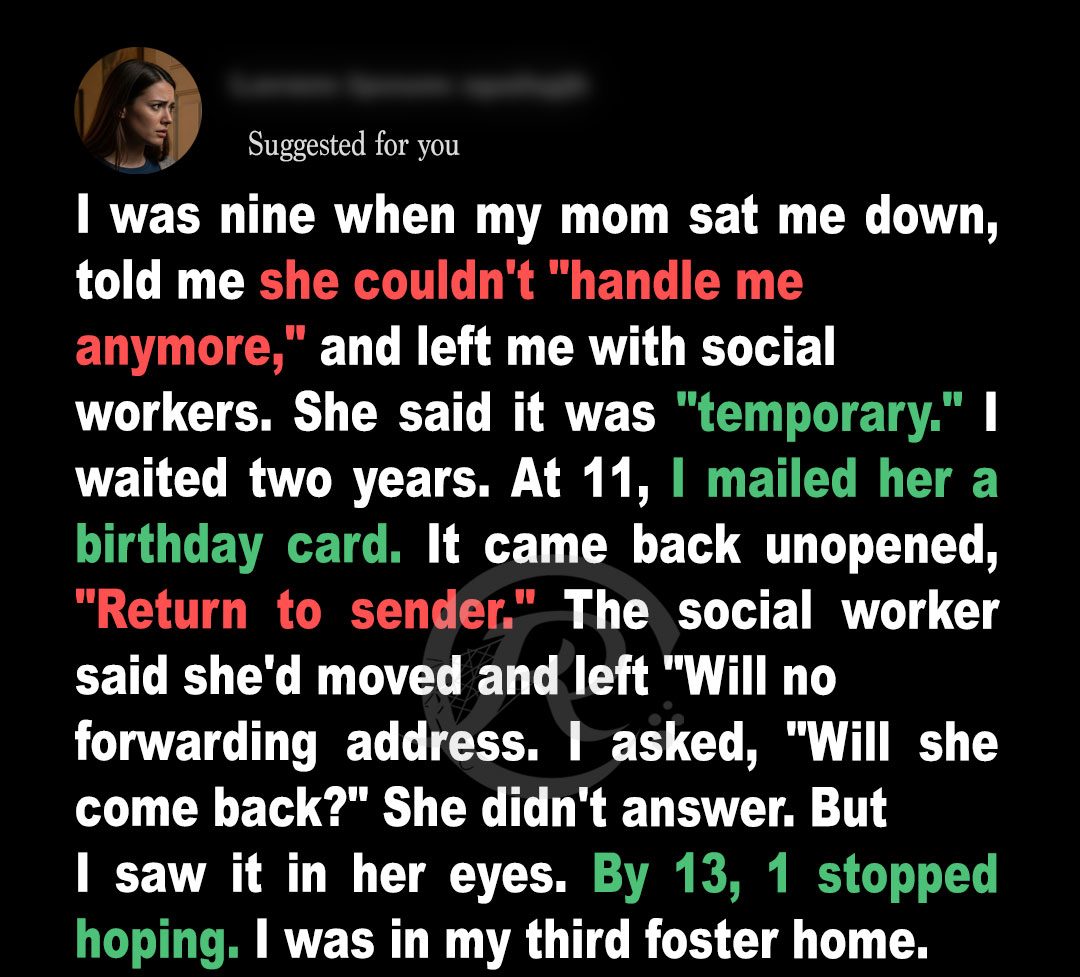
When I was nine, I came home bursting with news I’d aced a spelling test — only to find her staring at “custody” papers. She said she couldn’t take care of me anymore and handed my clothes in a garbage bag to a social worker. She promised she’d be “back soon.” I believed her.
For two years, I clung to that word “soon.” I told teachers and counselors the same thing: “She’s coming back.” I even mailed her a birthday card when I was 11 — only to have it returned stamped Return to Sender. That moment taught me the first lesson of my life: hope could hurt.
By 27, I had built a life I was proud of — a loving husband, Jake, a beautiful daughter, Emma, and a warm home filled with laughter and memories I vowed Emma would never lose. I became the mother I never had.
Then one evening, just as Emma was tucked into bed, I heard three firm knocks at the door. Standing there was a frail older woman holding a bag of cookies — the same eyes I recognized as my own. It was my mother, asking for help.
She didn’t ask how I was. Didn’t care about my family. She simply expected me to take her in. I paused — angry, hurt, but strangely curious. Maybe it was therapy lessons about “breaking the cycle.” Maybe it was the little girl inside me still longing for her mother. So I stepped aside and said: “Come in.”
At first, she seemed grateful. But it didn’t take long before her old patterns resurfaced: subtle digs, criticism cloaked as concern, reminders of how hard her life had been — yet never reflecting on what she put me through.
Then came the moment that changed everything. I walked in one afternoon to find my mother whispering to my daughter about how I had been “difficult” and “crying for no reason” as a child — painting me as unstable in front of Emma.
That was it. My heart didn’t break — it shut down. After Emma went to play, I packed my mother’s belongings into the same garbage bag she once used for mine. I told her:
“You abandoned me. There’s a shelter three blocks down — I called them.”
She left bitterly, warning me I’d regret it because “family is all you have in this world.” I answered calmly:
“Love is all you have. And you gave up the right to mine a long time ago.”
Weeks later I sent her a birthday card — just a plain white card with one sentence inside:
“Sometimes you have to step back from people who hurt you.”
It was not forgiveness. It was closure.
And this time, the cycle truly ended with me — giving Emma the love I never had, and the protection I always needed.