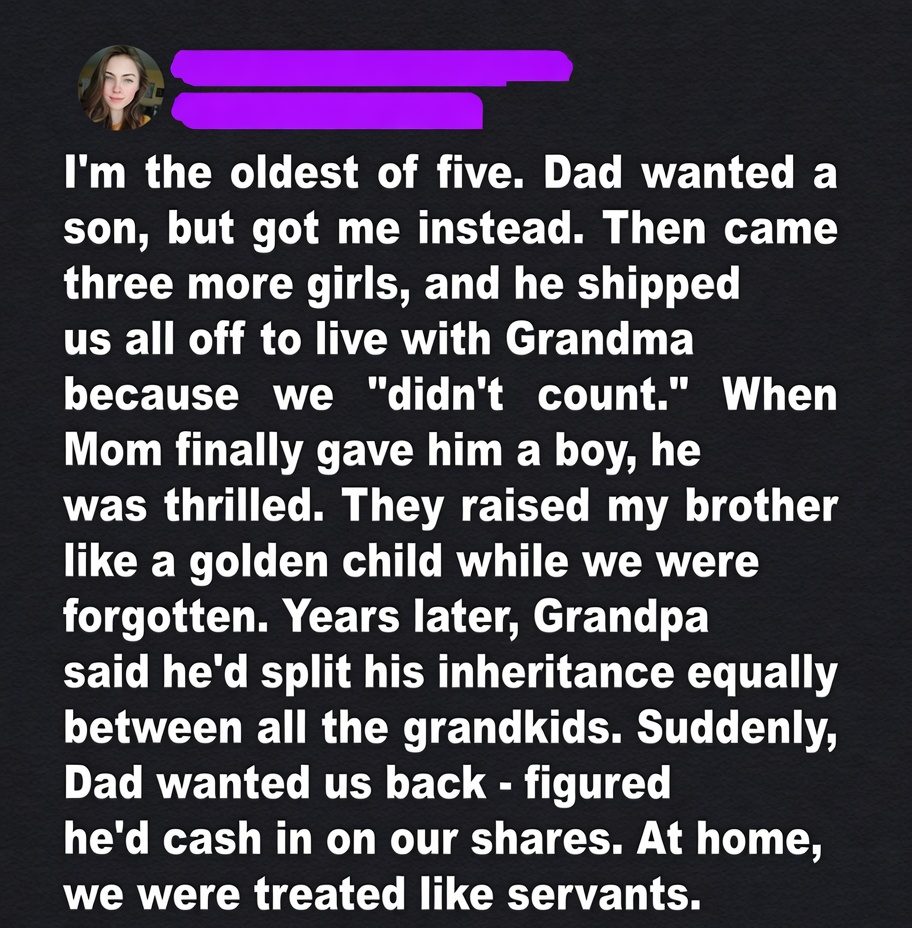
My father dumped me and my three sisters like we were junk mail, all because we weren’t boys. When I got older, I made sure he regretted it in a way he never saw coming — and it involved lawyers and courtrooms.
I’m 19 now, and I can still remember the first time I realized my father didn’t love me. I must’ve been five or six, sitting on the living room couch with a popsicle dripping down my hand. I stared at the family pictures on the mantle, especially the hospital photos. Dad wasn’t angry or sad in them. He just looked blank, like I was a mistake he couldn’t return.
I’m the oldest of five. My name’s Hannah. Then came Rachel, Lily, and Ava. Four girls, one after the other. To Dad, that was a problem.
He wanted a son and never hid it. He told Mom right after I was born, apparently in the hospital, “Don’t get too attached. We’ll try again.” He never said it in front of us, but you could feel it in everything he didn’t say. No hugs, no “I’m proud of you,” just silence and cold stares.
Each time Mom had another baby and it turned out to be a girl, he grew more bitter. By the time Ava was born, the resentment in our house was thick enough to choke on.
So he found a solution: out of sight, out of mind.
Dad started dropping us off with Grandma Louise one by one because we “didn’t count.” I was the first, a few months before my first birthday. Then Rachel, Lily, and Ava. He’d wait a few months, long enough to keep up appearances, then pack a bag and drop us off like forgotten donations at a thrift store.
Grandma never fought him. Not because she didn’t love us — she did — but because she was afraid of stirring the pot. “I didn’t want to risk him cutting off all contact,” she once admitted, clutching one of Ava’s old blankets. “I thought maybe, someday, he’d come around.”
Mom didn’t stop him either. Looking back, I don’t think she had the fight in her. She married young, dropped out of college to be a wife, and when Dad told her what to do, she did it, no questions asked.
I think part of her resented us too — not because we were girls, but because we kept showing up when she wasn’t ready to be a mother. She didn’t seem to hate us; she just didn’t seem to want us.
We grew up in Grandma Louise’s quiet little house, where she made cookies when we were sick and tucked us in with bedtime stories. She never raised her voice, and the only photos of us as babies were the ones she took herself. Whenever our birthdays rolled around, she made four little cakes, one for each of us, every time.
We didn’t hear from Mom or Dad much. The occasional birthday card signed “Love, Dad and Mom” with no message inside. I used to sleep with them under my pillow, pretending the words had just been erased by accident.
Then one night, when I was nine, Grandma’s phone rang while she was in the kitchen. Her shoulders tensed. She handed me a mug of cocoa and told me to take my sisters to the living room, but I didn’t listen. I pressed my ear to the wall.
“It’s a boy!” Mom’s voice was shaky with excitement on speakerphone. “We named him Benjamin.”
There was real, genuine laughter from Dad.
A week later, they visited for the first time in years. Not to see us, but to show off Benjamin. He was their miracle, their golden child. Benjamin wore designer baby clothes and had a silver rattle with his name engraved. I’ll never forget the way Dad beamed while holding him — that was the father we’d never known.
After that, they vanished again, raising Benjamin like royalty. We didn’t get updates and weren’t even invited to his birthdays. It was like we didn’t exist.
I thought that was the end of it, that we’d been discarded for good.
Then, almost out of nowhere, everything changed.
When I was 17, a lawyer showed up at Grandma’s house asking questions about her ex-husband, my estranged grandfather Henry. My sisters and I didn’t know him. He’d left Grandma decades ago, before I was born. The story was that he couldn’t handle family life and walked out. Grandma said he wasn’t a bad man, just lost.
Apparently, he’d made something of himself — ran a construction company, bought land, stocks, assets. And now? He was dying.
The lawyer was gathering family details for estate planning. “His estate will be split among his direct grandchildren,” he said politely. “Unless there are any objections.”
Grandma, not thinking twice, said our names. That’s how it started.
She didn’t know Dad had been snooping around her mailbox or that he’d find the lawyer’s return address. Or that he’d look it up and see the word “inheritance” under Henry’s name. But he did.
A few weeks later, Dad and Mom showed up unannounced at Grandma’s with big fake smiles and a U-Haul.
“We thought it was time to reconnect,” Dad said.
Grandma was speechless.
“It’s been too long,” Mom added quietly, eyes darting toward us girls.
I stepped outside, hands shaking. “Why now?”
Dad didn’t blink. “We want you home, where you belong.”
They packed us up that same night.
Grandma didn’t stop them. Not because she agreed, but because she didn’t have the legal power. She’d never filed for guardianship. She always hoped our parents would come back on their own, out of love.
Now they had — but it wasn’t because of love.
We moved back into a house that wasn’t ours. My old room had been turned into Benjamin’s Lego paradise. We were split between couches and sleeping bags.
Benjamin was seven and already spoiled rotten. He looked at us like we were strangers in his kingdom.
“Why are the girl-servants here?” he whispered to Mom once, loud enough for us to hear.
Rachel cried that night, and Ava slept with a flashlight on.
We were “reunited,” but it was clear why. My sisters and I were just “the help.” We did the dishes, laundry, babysitting — every chore was ours. Mom barely looked at us while Dad barked orders. Benjamin mimicked them both, calling us “useless girls” like it was a family joke.
I held out for three weeks. Three weeks of cold dinners, chore charts, and Benjamin stomping around like a tiny tyrant. Three weeks of Mom acting like we were burdens. Three weeks of Dad ignoring us unless he needed something scrubbed.
One morning, I packed a bag, kissed my sisters goodbye, and slipped out before dawn.
I walked six miles to the only person who might actually care.
Grandpa Henry lived on the edge of town in a white house with ivy-covered fences. I got his address from one of the letters Dad had stolen from Grandma. My grandfather answered the door in slippers and a robe. He looked surprised, frail, but not angry.
“You must be Hannah,” he said, his voice gravelly as he recognized me instantly. “Come in.”
Although he and Grandma weren’t together anymore, she had still sent him updated pictures of us throughout the years, insisting that we were still his grandchildren.
I told him everything. I didn’t cry until I mentioned Ava calling herself “the spare girl.”
He didn’t say much at first, just stared at his hands.
“I left your grandmother because I thought she’d be better off without me,” he said quietly. “I was wrong about a lot of things back then.”
Then he listened as I explained what Dad had done — shipping us off, ignoring us for years, and now using us for the inheritance.
Grandpa’s eyes hardened. “He won’t get a cent of what’s yours.”
With Grandpa’s help, we got lawyers involved. We filed for emancipation for me and protective orders for my sisters. We proved the neglect, the abandonment, and Dad’s clear motive of greed. The court granted us control over our shares of the inheritance and kept Dad far away from it.
Dad tried to fight it, of course. He showed up at hearings with fake tears and stories about how he’d “always loved his girls.” But the evidence was too strong — the years of silence, the sudden “reunion,” Benjamin’s cruel words caught on recordings we’d made.
In the end, the judge saw right through him.
Dad lost access to the money. He lost any claim to us. And worst of all for him, he lost the son he’d pinned all his hopes on when Benjamin grew up and saw the truth about how his father had treated his sisters. Even Mom eventually distanced herself when the reality hit.
Years later, I still remember the look on Dad’s face in that courtroom — pure regret when he realized the daughters he’d thrown away were the ones who finally made him pay.
We went back to Grandma’s after it was all over. She hugged us tighter than ever, and we finally had the family we deserved — one built on love, not conditions.
Sometimes the people who are supposed to love you unconditionally are the ones who teach you the hardest lessons.
And sometimes, the best revenge isn’t loud or dramatic.
It’s simply taking back what was always yours — and leaving them with nothing but the regret they earned.