The banquet hall gleamed under a canopy of lights. Champagne flutes clinked, laughter flowed — this was my retirement party, the grand finale of decades of hard work. I stood surrounded by colleagues, friends, and family. My son, beside me, smiled proudly. Everything felt perfect.
Speeches began. Warm memories. Shared achievements. Then my son took the mic. His voice choked with emotion, he thanked everyone — especially me. I felt tears prick my eyes. This was why I worked so hard.
And then it was her turn.
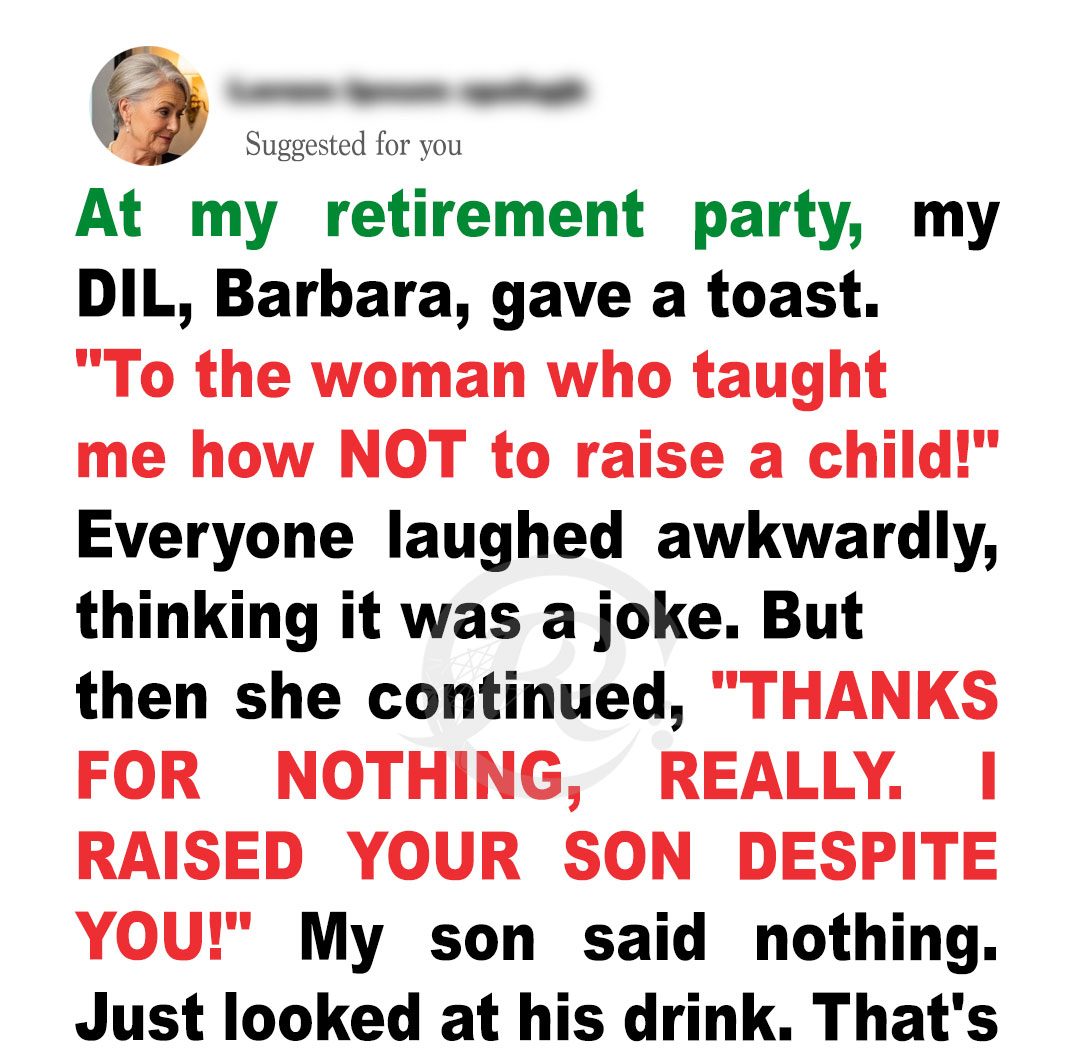
My daughter-in-law stepped up with a practiced smile. At first her words were polite: gratitude, celebration. But then her gaze locked onto mine — and her tone shifted.
“Thank you for nothing,” she said, pausing so the room could absorb every syllable. “I raised your son despite you.”
The silence that followed was like a punch to the chest. The room stilled. My carefully built world — years of sacrifice and love — felt as if it had collapsed in an instant. My son went pale, mortified. She held my stare, cool and unrepentant.
I had tolerated her subtle digs for years — little jabs about my parenting, the way she’d always imply I wasn’t supportive enough. She prided herself on being “sweet,” but underneath was a sharp edge, a challenge to my place in my son’s life.
I forced a stiff smile.
“Thank you for those… thoughtful words,” I said, barely above a whisper, raising my glass not to her, but to my son — the boy I had always loved fiercely.
That night, I couldn’t sleep. Her toast replayed in my mind again and again. “Thanks for nothing.” Her words felt like a verdict — a public declaration of her victory. I knew I couldn’t just ignore it.
I was retiring with a significant nest egg — life’s savings meant to give my son a secure future. And for years I had supported them financially: gifts, loans, help with renovations, a down payment… all given freely, with love. They expected my continued generosity.
The next morning, instead of relaxing, I called my lawyer. I instructed him to revise my will immediately. My son would receive a modest inheritance — enough to live comfortably — but everything that could benefit my daughter-in-law was cut. No access, no indirect pathways, no chance for her to touch a single cent.
I also withdrew the loan I’d given them for their house renovation — demanding immediate repayment. Every financial support I had provided? Terminated. Gone.
I felt a cold satisfaction. She got what she’d earned. My son protested — confused, torn.
“She didn’t mean it that way,” he said.
“She was just upset,” he pleaded.
But I stood firm.
“She knew exactly what she said,” I told him.
Weeks passed. Calls from him became rarer. The distance between us grew, then widened into silence. The grandchildren I adored became strangers, seen only in rare, awkward encounters. I told myself her influence had poisoned the relationship. I clung to the righteous anger that I thought gave me justice.
Then one day, an envelope arrived.
It wasn’t from my son — it was from his grief counselor. Inside was a letter he had shared in therapy — a carefully penned account of his lifelong struggle with abandonment and emotional pain, a trauma deep enough that it had shaped his entire life.
And at the heart of it was the truth I had buried for decades.
My son’s father — the man I had told him died a hero in a distant land — had not died at all. He had simply left us. No noble sacrifice. No grand disappearance. Just abandonment. And I had invented a story to spare my son that pain.
The letter revealed that when my son finally discovered the truth, it shattered him. And it was his wife — my daughter-in-law — who helped him face it, helped him heal, helped him rebuild himself from the damage that lie had caused. She didn’t raise him despite me — she helped him heal beyond me.
As I read the final line — “It wasn’t that she raised me instead of you. It’s that she helped me finally raise myself…” — tears blurred the words.
Suddenly her words at the party weren’t an attack. They were a desperate cry for recognition of truth, and my reaction had pushed him further away.
I thought I had delivered justice.
But in my blind rage, I had lost the one person I truly loved and isolated the very person who had helped him heal.
And now, I faced the harshest truth of all: I hadn’t punished her — I had punished myself with utter, desolate loneliness.