I never expected life to take such a dramatic turn in my late 50s — and definitely not that it would still surprise me in my late 70s. But it did.
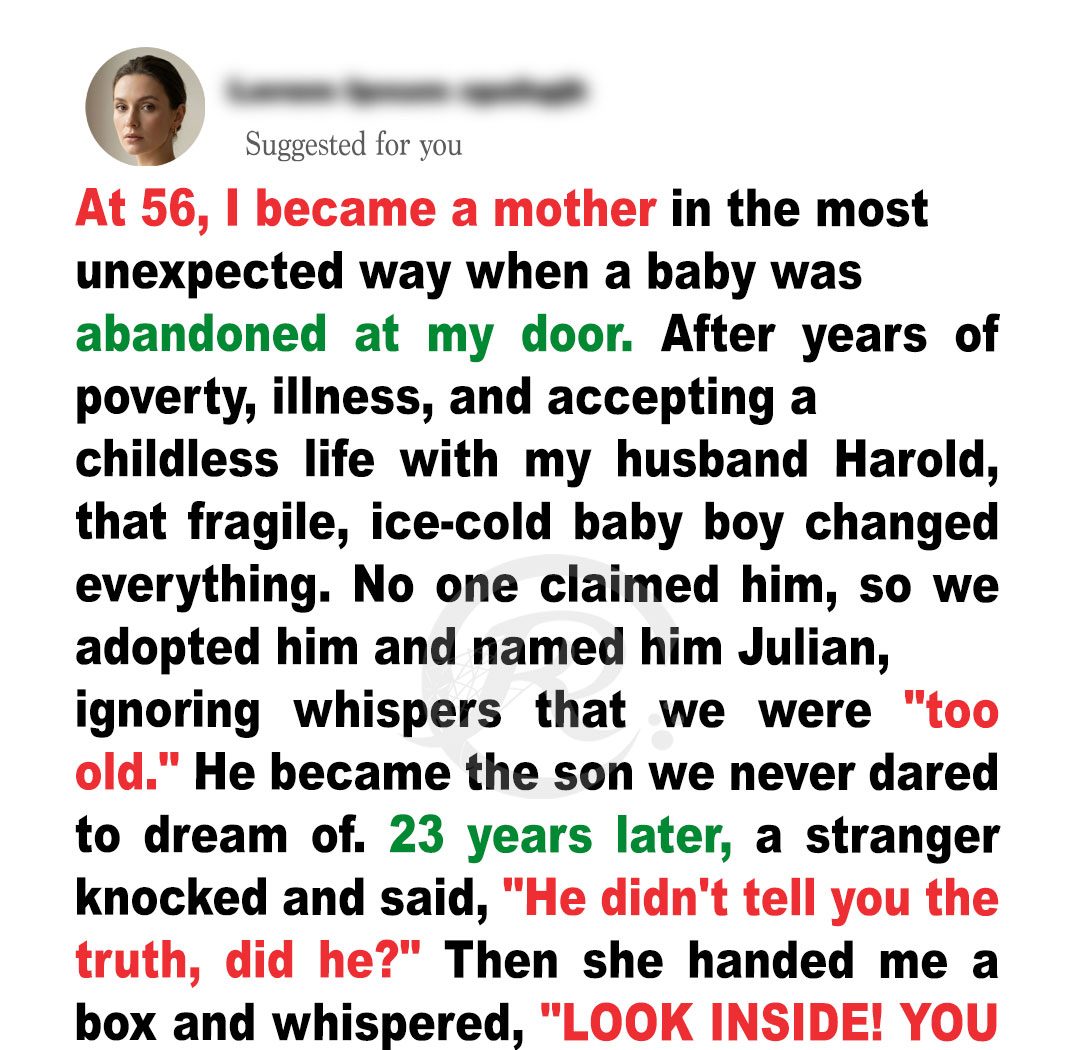
I’m Eleanor, 79 now, and my husband Harold is 81. We’d lived a quiet life — retired, simple, and without children by choice and then by circumstance. When I was in my 50s, a health crisis took us by surprise and the dream of becoming parents slipped away forever.
Then one cold winter morning changed everything.
It was after a harsh night when I heard something strange — a soft cry outside. At first, I thought it was the wind… until I realized it was a baby.
There, on our frozen doorstep, inside a little basket, was a tiny boy — barely wrapped, his face pink with cold. Without thinking, I yelled for Harold and we rushed him inside. 911 was called, blankets were wrapped tight, and moments later lights and uniforms filled our home.
There was no note. No clue. Just that fragile sound of a newborn asking, somehow, to be found.
We decided — almost without hesitation — that we wanted to adopt him. People thought we were crazy. “You’ll be in your 70s when he’s a teen,” they said.
But we didn’t care.
We named him Julian. And what a gift he became. Smart, kind, loyal — the kind of son any parent would be proud to call their own.
Through childhood, college, and into adulthood, Julian stayed close — calling every week, dinner Sunday nights, gentle hugs when he came in the door.
When Julian was 23, we heard another knock at the door — not urgent, just calm. A woman we didn’t know stood there, holding a box.
She introduced herself as Marianne, Julian’s attorney, and asked if we were sure we wanted to see what he’d been hiding from us.
Inside the box were documents — legal papers, photos of a couple dressed in wealth, and a letter from his biological parents’ will. They had died in a car accident and left everything to Julian.
The twist? They weren’t poor strangers who left him out in the cold by accident. They were a wealthy family who abandoned him at birth because doctors warned of possible health issues.
When Julian found out, his reaction was powerful — and honest. He refused to accept the identity or legacy of these parents, choosing instead the people who actually raised and loved him.
We sat around our kitchen table, documents spread out, heartbeats loud in the quiet. When we asked if he would take the inheritance, he said:
“They didn’t open the door for me. You did. That’s the difference.”
He chose gratitude, not bloodlines. He chose love over legacy. And that was his answer.
In the end, Julian didn’t want the money for himself. Instead, he chose to decide what to do with it — maybe charity, maybe something good for others — but not at the cost of his identity or our family.
And as he hugged us before leaving that night, he said something that hit home:
“Family isn’t who shares your DNA. It’s who opens the door when you’re freezing.”